
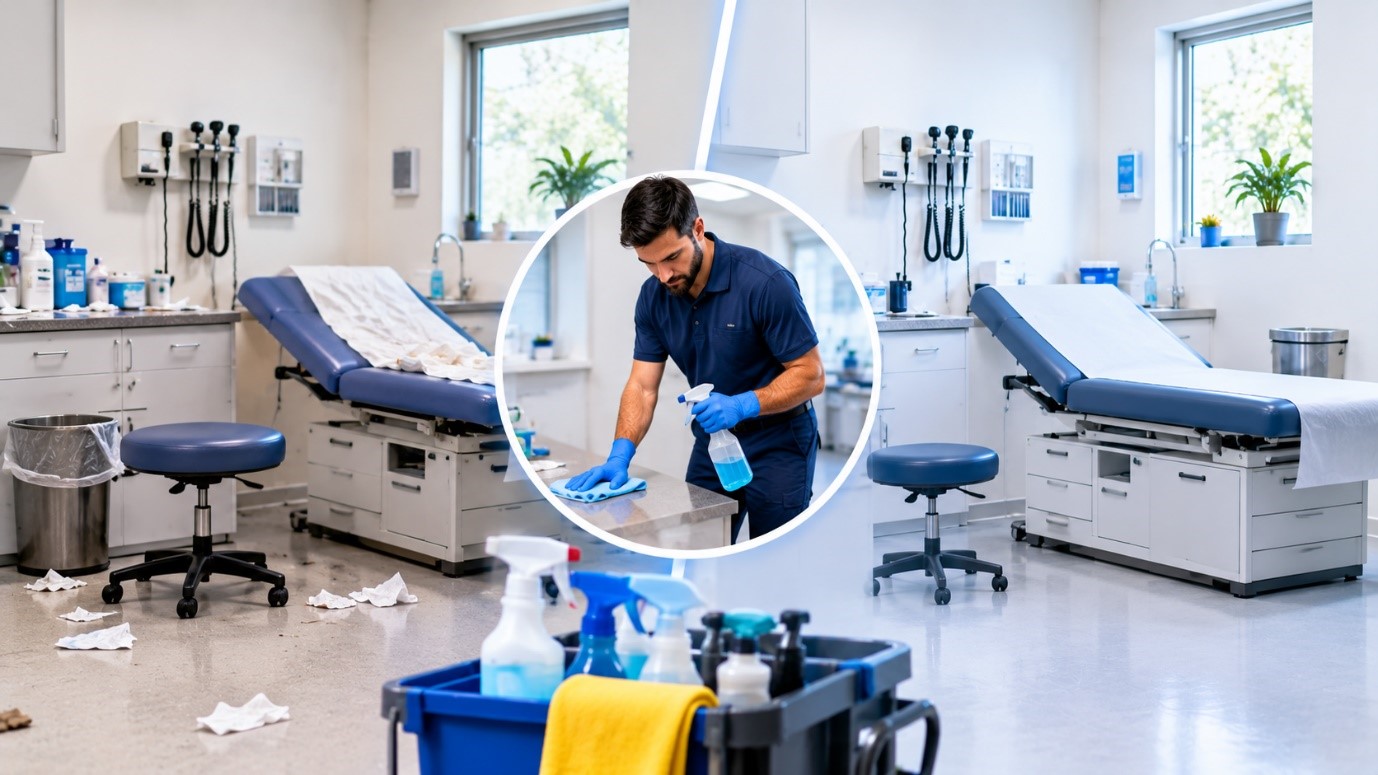
A medical office cleaning checklist includes disinfecting exam tables and high-touch surfaces between patients, cleaning and restocking restrooms daily, mopping floors with hospital-grade disinfectant, and weekly deep tasks like vents, chairs, and storage areas.
Most practices already have a version of this clinic cleaning checklist. The problem is that it lives in someone’s head, or it mixes clinical tasks and building tasks so nobody knows who owns what.
This guide splits the work the way a practice really runs, shows you how frequently each task should happen, and spells out the jobs a cleaning crew should never touch.
We provide medical office cleaning for practices across Springfield and the Ozarks, so we write this for the practice manager who wants fewer surprises, not more paperwork.
Medical Office Cleaning Checklist in Brief
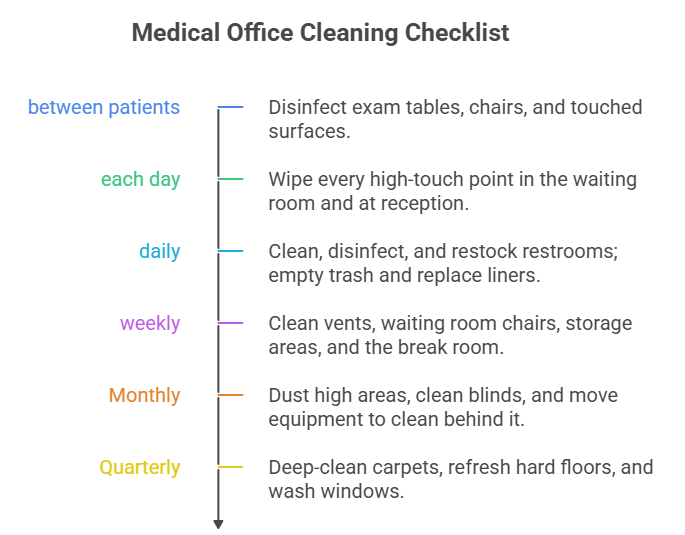
Keep this short version at the front desk. Every item gets a detailed breakdown below.
- Disinfect exam tables, chairs, and touched surfaces between patients.
- Wipe every high-touch point in the waiting room and at reception each day.
- Clean, disinfect, and restock restrooms daily.
- Empty trash daily and replace liners.
- Mop floors with an EPA-registered, hospital-grade disinfectant.
- Clean sinks and counters, and keep soap and paper supplies stocked.
- Spot-clean walls, doors, and glass.
- Weekly, clean vents, waiting room chairs, storage areas, and the break room.
- Monthly, dust high areas, clean blinds, and move equipment to clean behind it.
- Quarterly, deep-clean carpets, refresh hard floors, and wash windows.
Where Medical Office Cleaning Splits From Regular Office Cleaning
A regular office worries about how things look. A medical office worries about what moves from one patient to the next. That shift changes who does which job, which products are allowed, and how closely each task is timed.
The biggest difference is the line between clinical work and building work. Your clinical team handles anything tied to patient care, and a cleaning team handles the rest of the building. Your own plan sets the exact split, and your medical office cleaning checklist should name which side owns each task. It usually looks like this.
If you want the standard office baseline before layering on clinical rules, our commercial cleaning services show how a building plan is built from the walkthrough up.
Daily Medical Office Cleaning Checklist by Room
Daily work is where infection control is won or lost, so this section gets the most detail. Use it as your working medical office cleaning checklist for every opening and closing shift, and as a healthcare cleaning checklist that your whole team can read in one minute.
Exam Rooms
This is the exam room cleaning checklist your team repeats all day, and your cleaning crew repeats at night.
- Disinfect the exam table, stool, and chair armrests after every patient, following the product’s contact time.
- Wipe counters, door handles, light switches, and the sink and faucet.
- Replace table paper and restock gloves, wipes, and supplies.
- Check under cabinet edges, drawer pulls, and the base of the exam light, where wipe-downs usually stop.
- Empty regular trash. Leave regulated waste to trained clinical staff.
- Clean floors last, working from the back of the room toward the door.
- At close of day, run a full end-of-day reset, also called terminal cleaning, on every room that saw patients.
Waiting Room
Your waiting room is where every patient and visitor meets, so it picks up the widest range of germs.
- Wipe chair arms, seat edges, tables, and magazine racks.
- Disinfect door handles, push plates, and check-in kiosks.
- Clean glass, entry mats, and the floor, including along baseboards.
- Treat this like any doctor’s office cleaning checklist, and decide on a toy and magazine policy. Hard toys need wiping, and soft ones are hard to clean at all.
Restrooms
Clinic restrooms see steady traffic all day, and some of those patients are sick.
- Disinfect toilets, seats, sinks, faucets, and door handles.
- Clean mirrors, dispensers, and baby-changing surfaces.
- Restock soap, towels, and tissue.
- Mop floors with disinfectant last.
Reception and Front Desk
This is a medical office cleaning checklist section that also touches on patient privacy.
- Wipe counters, phones, keyboards, pens, and card readers.
- Leave papers, charts, and screens exactly where they are. Your cleaning team should never read or move records.
- Empty shredding bins only through your own process.
The front office otherwise follows a typical office routine, and our office cleaning checklist covers that side in detail.
Why Between-Patient Pressure Causes Missed Spots
The hardest part of infection control is not knowing what to clean. It is finding the minute to do it when the schedule is full. Rooming gets rushed, wipe-downs get shortened, and contact time is the first thing that slips.
Plan for that pressure so it does not catch you off guard.
- Stock every room. Wipes, gloves, and paper should be within arm’s reach, so nobody leaves to find them.
- Choose a product with a realistic contact time. A product that needs ten minutes will be cut short in a busy hour.
- Leave buffer in the schedule. A few minutes between appointments protects both patients and staff.
- Assign an owner. One named person per room per shift removes the guessing.
Weekly Tasks Most Practices Skip
Weekly work picks up what daily cleaning leaves behind. These tasks stay invisible until a surveyor, an inspector, or a patient notices them, so add them to your medical office cleaning checklist as fixed weekly items.
- Vents and returns. Dust gathers here and recirculates.
- Waiting room upholstery. Vacuum seams and spot-clean fabric chairs.
- Storage rooms and supply closets. Dust shelves, sweep floors, and check for pests.
- Break room. Clean the refrigerator, microwave, and tables.
- Trash cans and bins. Wash and disinfect the cans themselves.
- Baseboards and door frames. Wipe the lower edges of every room.
This is also where a tailored schedule beats a generic one. Our commercial cleaning tips cover ways to keep weekly tasks from slipping.
Monthly and Quarterly Tasks That Keep the Building Ahead
Put these on your monthly and quarterly medical office cleaning checklist. They protect surfaces and finishes, and they prevent the slow buildup that makes daily cleaning harder.
- Monthly. Dust ceiling vents and high shelves, clean blinds, wipe cabinet fronts, and pull equipment forward to clean behind it.
- Quarterly. Extract carpets, refinish hard floors where needed, steam-clean upholstery, and wash exterior windows.
Frequencies vary with foot traffic and specialty. A busy pediatric office may need more than a small specialty practice, and dental practices add operatory tasks. Our guide on office cleaning frequency helps you set those intervals.
A Ten-Minute Monthly Audit
Cleaning plans drift. A short audit catches the drift before an inspector does.
- Pick three rooms at random, including one restroom.
- Walk each room with your written plan in hand.
- Check one low spot, one high spot, and one hidden spot, such as under a counter lip or behind a door.
- Note anything that is missed and send it to your cleaning lead the same day.
Do this once a month, and the plan stays honest.
Every High-Touch Surface Worth Naming
High-touch surfaces carry most of the transfer risk, so list them on paper. Your team forgets what is not written down.
- Door handles, push plates, and entry glass.
- Light switches and thermostats.
- Check-in pens, clipboards, and kiosks.
- Chair arms and seat edges.
- Reception counters, phones, and keyboards.
- Exam table edges and rails.
- Faucet handles and paper towel dispensers.
- Restroom door handles and stall latches.
- Card readers and payment terminals.
- Elevator buttons and stair railings.
A good medical office cleaning checklist treats these as a separate route, not an afterthought at the end of a shift.
Disinfectant Contact Time and Color-Coded Microfiber
Disinfecting only works when the product stays wet on the surface long enough. The CDC says dental teams should follow manufacturer directions on EPA-registered disinfectants, including dilution and contact time, and that grocery-store disinfectant wipes are not EPA-registered.
Healthcare practices should apply the same rule. The CDC does not recommend a specific disinfectant brand. That decision belongs to your practice, based on surface compatibility and label claims.
Your medical office cleaning checklist should list the product and contact time for each room. Two habits make this easier.
- Post the contact time. Put the label time on the wall of every room, so nobody guesses.
- Use color-coded microfiber. Assign one color per zone, such as restrooms, exam rooms, and general areas, so a cloth from the bathroom never touches an exam table. This keeps cross-contamination in check.
Also keep the Safety Data Sheet (SDS) for every chemical in one binder, and make sure cleaners know where it is. Cleaning, sanitizing, and disinfecting are three different jobs, and knowing the difference between these three helps you understand when each one applies. Never mix chemicals, and never use a high-level disinfectant on environmental surfaces.
OSHA and CDC Basics for Your Written Plan
You do not need to memorize regulations, but you do need a written plan. OSHA’s bloodborne pathogens standard requires employers to set a written cleaning schedule and method of decontamination based on the location in the facility and the type of surface. The same standard calls for an appropriate disinfectant on work surfaces.
For a practical read on current standards, our overview of healthcare facility cleaning standards walks through the main guidance. Treat this section as orientation, not compliance advice. Your compliance officer or state board has the final say.
Build your plan around four questions:
- What gets cleaned, and how frequently?
- Who does it, and what training do they have?
- Which product is used, and what is its contact time?
- Where are spills and incidents reported?
What Cleaners Should Never Touch
A clean building is the goal, but some jobs belong only to trained clinical staff. A good cleaning partner knows the boundary and respects it.
- Sharps containers. Regulated waste and sharps go into labeled, closable containers that employees are not supposed to open.
- Red-bag biohazard waste. Clinical staff bag, seal, and hand off regulated waste.
- Blood or body fluid spills. Only staff trained for bloodborne pathogens should respond.
- Instruments and sterilization areas. These need a clinical process, not a wipe-down.
- Patient records, medications, and specimens. Do not move, read, or clean around them.
- Lab equipment. Wipe only the outside surfaces your plan lists.
If your cleaners find something that belongs on this list, they should stop and tell your clinical lead. Write that instruction into your plan, so a new team member on a night shift knows exactly what to do. It protects them, and it protects your patients.
In-House Staff or a Professional Cleaning Team
Many practices start by asking their medical assistants to handle cleaning. That costs more than it looks. Clinical staff who spend 45 minutes on restrooms and floors are not rooming patients, and your payroll pays clinical rates for cleaning work.
A medical office cleaning checklist also helps you price outside help, because it shows how many staff hours the building side takes. A professional team takes the building side off your staff so clinical hours stay clinical.
Medical facility cleaning services also give you a documented routine, which is hard to keep up when the same people are rooming patients. The tradeoff is cost, and our janitorial service cost guide shows what drives it.
Here is what we put behind our commercial work:
- A regular named team. You know who enters your building, and we tell you if someone changes.
- A written cleaning plan. It lists what gets cleaned, in which rooms, and how frequently.
- After-hours service. Cleaning happens when patients are gone.
- First-Month Money-Back Guarantee. Tell us before month two begins, and we refund your first month’s recurring cleaning payment and end service.
- 48-hour correction promise. If something is missed, tell us within 48 hours, and we return at no added cost.
If your building also needs window cleaning, pressure washing, or floor care, our Business Services Coordinator arranges those vendors, so you have one call to make.
Printable Version for Your Back Office
Want a printable medical office cleaning checklist your team can initial? Copy the glance list above into a one-page table with five columns: task, frequency, product, initials, and date. Add a line at the bottom for your clinical lead’s sign-off.
A signed weekly page is also useful when you review your plan or answer an inspector. Keep the last few months on file, so you can see where tasks slip and fix the pattern.
FAQs
How frequently should exam rooms be disinfected?
Clinical surfaces should be disinfected between every patient. The full room, including floors and sinks, gets cleaned at the end of each day.
What is terminal cleaning in a medical office?
It is the thorough end-of-day cleaning of a room or area, covering surfaces, fixtures, and floors. It resets the space for the next day.
Can a general cleaning crew work in a clinic?
Yes, for building tasks like floors, restrooms, and waiting rooms. Clinical tasks, sharps, and regulated waste stay with trained medical staff.
Do cleaners need to follow HIPAA rules?
Yes. Anyone with after-hours access should leave records untouched, keep screens off-limits, and report anything left exposed.
Is a dental office cleaning checklist different from a clinic checklist?
The structure is the same, but dental operatories add chair, light, and unit waterline routines. Clinical staff manage those between patients.
Request a Medical Facility Cleaning Quote
A medical office cleaning checklist only helps if someone follows it every day. Whether you write your own plan or hand the building side to us, put it on paper, set the contact times, and name an owner for each task.
If you want us on the building side, we start with a walkthrough. We learn your rooms, hours, and access, then write a cleaning plan that fits your practice. Request a medical office cleaning quote, text us at (417) 719-1380, or email contact@mencancleantoo.com.